Tuesday, December 11, 2018

Thursday, December 6, 2018
Pecha Kucha
Pecha Kucha: https://docs.google.com/presentation/d/e/2PACX-1vREChTnsUmRLR5hCms-ZohdtsYg2lBm38iPJzFwCDoCIaDXQ_ezgsVnQB-TFN3DcVyP_CqeLlJEfy7i/pub?start=false&loop=false&delayms=20000&slide=id.g33a02a390f_0_90
Sunday, December 2, 2018
Shor Quotes
Empowering Education
By: Ira Shor

Link to reading: https://drive.google.com/file/d/0B-JcBFAuLc-0T0ZxUlEwOUNJWlU/view
By: Ira Shor
"They reported being bored and silenced didactic lectures in classes where teachers raced to cover the material and ignored their questions."
- Ariel stated that she doesn't retain information this way and I can agree. I don't retain information when the lectures are boring and rushed. I feel like rushing through lectures just to cover the material is one of the worse things you can do as a professor. Students are less likely to comprehend all the material when your rushing and not even answering their questions. Its important to allow students to ask questions so they can fully understand the material. Also, its important for teachers to teach the material in an interesting way so the students are retaining the material and are engaged.
“Students in empowering classes should be expected to develop skills and knowledge as well as high expectations for themselves. their education. and their futures”
- I feel like setting high expectations for students can be very beneficial. It pushes the students to try harder and do their very best. It also helps shape them as a person and student. It will help them be well prepared in their future.
"School funding is another political dimension of education, because more money has always been invested in the education of upper-class children and elite collegians than has been spent on students from lower-income homes and in community colleges"
- I agree that the upper-class children and elite collegians have an advantage educationally over the lower-income homes because more money is invested in the upper-class schools. Its not fair that upper-class has a better quality education. You would think that they would invest more money in the lower-income community colleges so they have the resources to perform better academically. Everyone deserves a quality education with all the resources they need to do so regardless of them being in upper or lower class.
Point to share: How do others feel about Shor's ideas of empowering education?
Link to reading: https://drive.google.com/file/d/0B-JcBFAuLc-0T0ZxUlEwOUNJWlU/view
Sunday, November 25, 2018
Jeannie Oakes
Why Schools Need to Take Another Route
By: Jeannie Oakes
I decided to do extended comments on Tiffany's blog on the quotes that she chose from this weeks reading.
“In low ability classes, for example, teachers seem to be less encouraging and more punitive, placing more emphasis on discipline and behavior and less on academic learning. Compared to teachers in high ability classes, they seem to be more concerned about getting students to follow directions, be on time and sit quietly. Students in low ability classes more often feel excluded from class activities and tend to find their classmates unfriendly. Their classes are more often interrupted by problems and arguing, while students in higher ability classes seem to be much more involved in their classwork.”
- Tiffany stated that this quote is saying that students in low ability classrooms aren’t encouraged the same way students in higher ability classes are encouraged and I agree. The teachers who are teaching the low ability group are focusing less on education and more on discipline and the students aren't learning how and what they supposed to be. There is so much negativity going on in the low ability classes that the students are not focused and are disengaged. She also stated that she thinks it's unfair that some students get better teachers because they're in a higher ability group and I completely agree. I think its extremely unfair to those in the lower ability groups. The teachers should be uplifting and encouraging their students, not bringing them down. I think the students in the lower ability groups should get better teachers so they can improve academically.
By: Jeannie Oakes
I decided to do extended comments on Tiffany's blog on the quotes that she chose from this weeks reading.
“In low ability classes, for example, teachers seem to be less encouraging and more punitive, placing more emphasis on discipline and behavior and less on academic learning. Compared to teachers in high ability classes, they seem to be more concerned about getting students to follow directions, be on time and sit quietly. Students in low ability classes more often feel excluded from class activities and tend to find their classmates unfriendly. Their classes are more often interrupted by problems and arguing, while students in higher ability classes seem to be much more involved in their classwork.”
- Tiffany stated that this quote is saying that students in low ability classrooms aren’t encouraged the same way students in higher ability classes are encouraged and I agree. The teachers who are teaching the low ability group are focusing less on education and more on discipline and the students aren't learning how and what they supposed to be. There is so much negativity going on in the low ability classes that the students are not focused and are disengaged. She also stated that she thinks it's unfair that some students get better teachers because they're in a higher ability group and I completely agree. I think its extremely unfair to those in the lower ability groups. The teachers should be uplifting and encouraging their students, not bringing them down. I think the students in the lower ability groups should get better teachers so they can improve academically.
“Students in the latter classes learned basic reading skills taught mostly by workbooks, kits, and easy to read stories. Learning tasks consists most often of memorizing and repeating answer back to the teacher. Since so much of importance was omitted from their curriculum, students in the low ability classes were likely to have little contact with the knowledge and skills that would allow them to move into higher classes or success if they got there.”
-Tiffany stated that this quote is saying that students in higher ability groups get taught essential reading and writing skills while students in low ability groups get taught the bare minimum of how to read and write and I agree. Students in high ability groups learn modern literature, reading, and library research as well as vocabulary that will help them on college essays. The main thing they learn is problem-solving skills and how to be critical thinkers. What the students in the high ability groups are learning will benefit them in the future when pursuing higher education. The students in the low ability groups are only the basic reading writing skills. They're learning the bare minimum to get by. The teachers teaching the low ability students are depriving them of a proper education and are not preparing them to be successful in the future. They're setting them up for failure instead of doing their job and helping them improve and succeed.
“Tracking leads to substantial differences in the day to day learning experiences students have at school. Moreover, the nature of these differences suggests that students who are placed in high ability groups have access to far richer schooling experiences than other students. This finding helps explain at least in part why it is that tracking sometimes seems to work for high ability students and not for others.”
-Tiffany stated that this quote is saying that students who are placed in high ability groups have access to better teachers and they receive a better education. While students in low ability groups have access to mediocre teachers and they receive a mediocre education and I agree. The students who are in the high ability groups have better teachers which result in a better education. They have high-quality teachers and learning experiences. They're prepared for a bright and successful future unlike the students in the low ability groups. They have less qualified teachers which results in a mediocre education. They're are unprepared and not was taught how and what they needed to be taught to have a bright and successful future like those students in the high ability groups. It's unfair.
Point to Share: How can we change the system so that all students have highly qualified teachers and a high-quality education?
Link to the reading:
Link to Tiffany's Blog Post:
Tuesday, November 20, 2018
Map of authors & connection to 3 authors
The first two authors I connect to are Garcia and Rodriguez. Rodriguez focuses on the separation of home and school languages that force students to leave a language behind to embrace another. During my service learning project I noticed that majority of my class was bilingual but only speak English in class. Sometimes ill over hear some students at lunch or recess talking in Spanish but in the classroom the students only speak English. I spoke to the teacher in my SL class and she said she over hears the students speak Spanish to each other sometimes and when they speak it to her and she doesn't understand, one of the students or the teacher assistant who is Hispanic will translate for her. She also stated that she had quite a few parents who don't speak or understand English so the teacher assistant or their child if possible will translate to her. For some of the students Spanish is their at home language and English is their at school language. The teacher is very accepting of the students speaking Spanish and just has someone translate to her. She makes them feel comfortable to speak both languages. The students and teacher assistant are helping each other communicate in both English and Spanish.
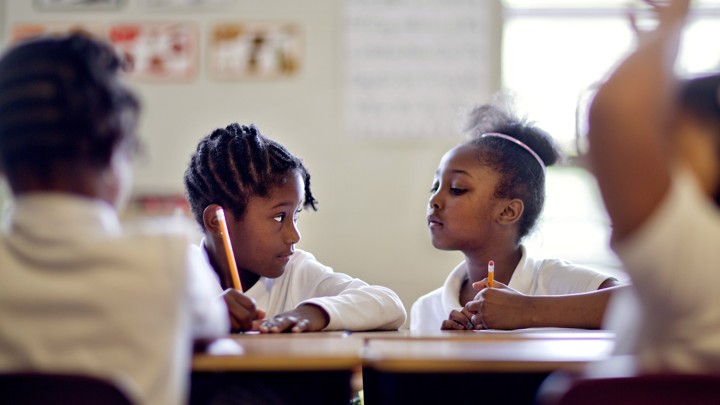
Another author I can connect to is Kliewer. There's a student in my SL class who shows he has a learning disability. The teacher and students don't look at him any different. While myself and other college students the teacher has us provide him extra support with the things he's struggling with. Sometimes while the students are doing independent work at their desks ill see him looking at his table mates papers and copy their answers. He's always so lost. He tries but most of the time, he doesn't get what's going on. The students never judged him. His table mates often try to help him with his worksheets and explain the directions to him. The teacher always tries to get him extra help. She doesn't label him as disabled or defective.

Link to Map the Authors:
https://docs.google.com/document/d/11ggYKeSZySby3EleiKzQ6zFwYD5hS4kLKjLbsvBMwQE/edit
Another author I can connect to is Kliewer. There's a student in my SL class who shows he has a learning disability. The teacher and students don't look at him any different. While myself and other college students the teacher has us provide him extra support with the things he's struggling with. Sometimes while the students are doing independent work at their desks ill see him looking at his table mates papers and copy their answers. He's always so lost. He tries but most of the time, he doesn't get what's going on. The students never judged him. His table mates often try to help him with his worksheets and explain the directions to him. The teacher always tries to get him extra help. She doesn't label him as disabled or defective.
Link to Map the Authors:
https://docs.google.com/document/d/11ggYKeSZySby3EleiKzQ6zFwYD5hS4kLKjLbsvBMwQE/edit
Sunday, November 11, 2018
Kliewer, McDermott & Varenne
Citizenship in school: Conceptualizing Down Syndrome By: Christopher Kliewer
"School citizenship rejects the idea of a gap between normality and Down Syndrome" (Kliewer 95).
- I agree with this quote. I don't think students with Down Syndrome or any other disability should have to be separated from those who don't have a disability. I feel like as long as the students with a disability have the proper scaffolding in the classroom than it would be a great idea. I know students who have disabilities who feel so left out and isolated because their separated from their peers. Students with and without a disability both deserve a proper and quality education and the students deserve to share the same learning environment with their peers.
"Shayne, however, did not see Isaac, or any of her students, as defective. In her classroom, which contained 6 students clinically identified as disabled (3 with Down syndrome, including Isaac) and 10 students considered non-disabled, Shayne and her associates worked to create a context that supported all children's full participation."
-As a teacher you should never see your students as defective, disability or not. Many teachers label their students with disabilities defective. She saw her students for who they really are not the disability they have. I work in a classroom with seven students who are on the autism spectrum but two of the seven students disability is more severe than the others. There's a staff in the classroom who I seen during certain groups and activities had the students not participate much because they "cant". Seeing that made me so upset because they can. They can at least try if given the opportunity. Just because someone has a disability doesn't mean you leave them out of groups and activities. Everyone deserves to participate in activities even if its harder for those with a disability. It was awesome to read that the teacher and her colleagues were creating context that supported all children.
"School citizenship rejects the idea of a gap between normality and Down Syndrome" (Kliewer 95).
- I agree with this quote. I don't think students with Down Syndrome or any other disability should have to be separated from those who don't have a disability. I feel like as long as the students with a disability have the proper scaffolding in the classroom than it would be a great idea. I know students who have disabilities who feel so left out and isolated because their separated from their peers. Students with and without a disability both deserve a proper and quality education and the students deserve to share the same learning environment with their peers.
"Shayne, however, did not see Isaac, or any of her students, as defective. In her classroom, which contained 6 students clinically identified as disabled (3 with Down syndrome, including Isaac) and 10 students considered non-disabled, Shayne and her associates worked to create a context that supported all children's full participation."
-As a teacher you should never see your students as defective, disability or not. Many teachers label their students with disabilities defective. She saw her students for who they really are not the disability they have. I work in a classroom with seven students who are on the autism spectrum but two of the seven students disability is more severe than the others. There's a staff in the classroom who I seen during certain groups and activities had the students not participate much because they "cant". Seeing that made me so upset because they can. They can at least try if given the opportunity. Just because someone has a disability doesn't mean you leave them out of groups and activities. Everyone deserves to participate in activities even if its harder for those with a disability. It was awesome to read that the teacher and her colleagues were creating context that supported all children.
McDermott & Varenne ; Culture "as" Disability
"Common sense allows that persons unable to handle a difficult problem can be labeled "disabled." Social analysis shows that being labeled often invites a public response that multiplies the difficulties facing the seemingly unable. Cultural analysis shows that disability refers most precisely to inadequate performances only on tasks that are arbitrarily circumscribed from daily life. disabilities are less the property of persons than they are moments in a cultural focus. Everyone in any culture is subject to being labeled and disabled."


- Its sad because people with disabilities face these labels everyday. Everyone gets labeled. Once your labeled and people already view you one way its hard to undo that. People automatically have thoughts and opinions of you and its hard to change them. The label of a disability can change someone's life in every way. Also, I don't get why someone would be labeled "disabled" if their unable to do a task. Not everyone can do every task, disability or not. This is relevant to the article because the author is talking about how culture is a disability.
Point to share: How do others feel about students with disabilities being in the same classroom as students with no disability?
Link to Readings:
https://drive.google.com/file/d/1mzLNrk6d8WMNzipSieLlf5L-KQxXhSTl/view
https://drive.google.com/file/d/0B-JcBFAuLc-0bXVmZVR4ODI0RHc/view
Sunday, November 4, 2018
American Life, Herbert & Brown vs. Board of Education
The Problem We All Live With (Part One)

"Maria usually brought home A's but when she got a C Neshia asked the teacher why she had not been notified, the teacher told her that she had to many kids in her class to call all of their parents. Neshia said teachers did not seem to care. Classes were dumbed down, and often unorganized, and everything that seemed to be good news turned into bad news."
-This quote is showing how the school really operates. It doesn't matter if she had too many kids in her class. Its still her job to notify parents when necessary. The teacher obviously didn't care that her student went from getting A's to a C. There's so much more to being a teacher then just teaching. As a teacher you should care for your students and do everything in your power to help them succeed. Because of how that school was being operated the students were suffering. The students wasn't being properly educated and set up for success. Because of the lack of organization of the school there wasn't any many students graduating as there should be. Classes shouldn't be dumbed down, if anything they should be challenging the students to test their limits. This quote is relevant to the podcast because the speaker was talking about the school district and all the problems parents were finding out that their children were facing.
Separate and Unequal by Bob Herbert
"Studies have shown that it is not the race of the students that is significant, but rather the improved all-around environment of schools with better teachers, fewer classroom disruptions, pupils who are more engaged academically, parents who are more involved, and so on. The poorer students benefit from the more affluent environment."
-I wouldn't even think that the race of students is what is significant. I would think it was the overall environment of the school. I completely agree with the quote. I believe any student would do significantly better in a school where they had great teachers and less classroom disruptions. Great teachers plays a huge part in a students success in the classroom. Students who have great teacher tend to be more engaged in what their learning in class. Classrooms with less disruptions is great because more students are engaged and focusing on their academics. Also, parent involvement can play a huge part in a students life. I think a student can be successful with or without parent involvement, its just a lot more challenging and they may face more obstacles then others with parent involvement. But overall, I agree that not just poorer students benefit from the more affluent environment but all students do.
Separate and Unequal by Bob Herbert
"Schools are no longer legally segregated, but because of residential patterns, housing discrimination, economic disparities and long-held custom, they most emphatically are in reality"
"Schools are no longer legally segregated, but because of residential patterns, housing discrimination, economic disparities and long-held custom, they most emphatically are in reality"
-Its sad that this is reality. Students living in a poor income area should have the same chance as students living in a high income area. The school funding shouldn't be based off poor or high income areas. That's not fair to the students that live in the poor income area. Those students are struggling and doing significantly lower then the students in a high income area because of something that's out of their control. All students should have the same the opportunities no matter what school they go to and no matter what area the school is in. They should all be allowed a great education, with qualified teachers and all around great school environment.
Point to share: How do others feel about schools in poor income areas having less funding than schools in high income areas?
Point to share: How do others feel about schools in poor income areas having less funding than schools in high income areas?
Link to readings:
-https://www.thisamericanlife.org/562/the-problem-we-all-live-with-part-one
-https://www.nytimes.com/2011/03/22/opinion/22herbert.html
Subscribe to:
Comments (Atom)